
Introduction: Understanding India’s Complex History of Communal Riots
India is a country known for its cultural diversity, religious traditions, languages, and communities living together for centuries. However, alongside this diversity, the nation has also experienced periods of social tension and communal violence. The India riots history reflects some of the most challenging moments in the country’s journey, where conflicts between communities caused loss of life, displacement, and long-lasting social effects.
Communal riots in India have occurred due to a combination of political disputes, religious tensions, economic competition, misinformation, historical disagreements, and social divisions. While each incident had its own causes and circumstances, many riots shared common patterns, including the spread of fear, the use of inflammatory speeches, and the involvement of organized groups.
Studying the major riots in India is important because understanding the past helps society recognize warning signs, promote peace, and build stronger relationships between communities. Historical awareness allows citizens to learn from mistakes and work toward a more inclusive future.
For readers interested in exploring more stories, social issues, and important events shaping modern India, platforms like Urban Union News provide informative discussions on topics connected to society, history, and current affairs.
What Are Communal Riots in India?
Communal riots are violent conflicts between groups belonging to different religious, ethnic, or social communities. In India, the term is mainly used to describe clashes involving religious communities, especially between Hindus and Muslims, although conflicts involving other groups have also occurred.
The causes behind communal violence are rarely simple. Often, several factors combine to create an environment where tensions increase.
Some common causes include:
- Political competition and attempts to gain public support through division
- Religious misunderstandings and propaganda
- Historical disputes and unresolved grievances
- Rumors spread through media or social networks
- Economic and social inequalities
- Local conflicts that grow into larger violence
The history of communal riots in India shows that violence often begins with a specific incident but becomes widespread when emotions are manipulated or misinformation spreads quickly.
Early Examples of Communal Violence During Colonial India
Communal Tensions Under British Rule
The roots of many modern discussions about communal violence in India can be traced back to the colonial period. British rule introduced several administrative and political systems that affected relationships between different communities.
The policy of separating communities through political representation and identity-based classifications contributed to growing divisions in some areas. Historians continue to debate the exact role of colonial policies, but many agree that political competition around religious identity increased during this period.
The Partition of India in 1947
One of the most devastating episodes in the India riots history occurred during the Partition of India in 1947.
When British India was divided into India and Pakistan, millions of people crossed borders based on religious identity. The movement of populations was accompanied by widespread communal violence.
The Partition riots resulted in:
- Massive loss of life
- Large-scale migration
- Destruction of homes and communities
- Deep emotional trauma among survivors
The events of 1947 influenced communal relationships for decades and remain one of the most significant chapters in South Asian history.
Major Riots in India and Their Impact
1. Jabalpur Riots (1961)
The Jabalpur riots were among the major communal conflicts in independent India. The violence occurred after tensions developed between Hindu and Muslim communities in Madhya Pradesh.
The incident highlighted how local disputes could quickly become communal conflicts. It also raised concerns about the ability of authorities to prevent violence and protect vulnerable communities.
The impact of the riots included:
- Loss of lives and property
- Increased fear between communities
- Discussions about improving law enforcement responses
The Jabalpur violence became an example of the challenges India faced while managing communal harmony after independence.
2. Ahmedabad Riots (1969)
The Ahmedabad riots of 1969 were among the deadliest communal riots in post-independence India at that time. Violence between Hindu and Muslim communities spread across parts of Gujarat.
The conflict resulted in significant casualties and property damage. The riots affected social relationships in Ahmedabad and influenced later discussions about communal tensions in Gujarat.
Major lessons from the incident included:
- The importance of quick administrative action
- The danger of rumors during tense situations
- The need for community-level peace efforts
3. Moradabad Riots (1980)
The Moradabad riots took place in Uttar Pradesh in 1980 and became one of the major communal conflicts of that decade.
The violence started after tensions during a religious gathering and later expanded. The incident showed how disagreements around religious events could become serious conflicts without effective communication and intervention.
The riots had a lasting impact on local communities and increased concerns about trust between citizens and authorities.
4. Nellie Massacre (1983)
The Nellie violence in Assam in 1983 remains one of the most tragic episodes of mass violence in India.
The conflict occurred during a period of political instability and tensions related to identity, migration, and citizenship issues. Large numbers of people were killed, and the incident left deep scars among affected communities.
The tragedy demonstrated how political conflicts connected with identity issues can create serious humanitarian consequences.
5. Anti-Sikh Riots (1984)
The anti-Sikh riots of 1984 followed the assassination of Prime Minister Indira Gandhi by her Sikh bodyguards.
Violence against Sikh communities occurred in several parts of India, especially in Delhi. Thousands of Sikhs were killed, and many families suffered displacement and trauma.
The aftermath raised important questions about:
- Protection of minority communities
- Accountability for violence
- The role of political leadership
- Justice for victims
The 1984 riots remain one of the most painful examples of communal violence in modern Indian history.
6. Bhagalpur Riots (1989)
The Bhagalpur riots occurred in Bihar in 1989 and were among the most serious communal conflicts in India.
The violence continued for several weeks and caused widespread destruction. Many people lost their lives, homes, and livelihoods.
The incident showed how prolonged communal tension could deeply affect social relationships and economic development.
7. Mumbai Riots (1992–1993)
The Mumbai riots followed the demolition of the Babri Masjid in Ayodhya in December 1992.
The violence between Hindu and Muslim communities affected different parts of Mumbai. The riots were followed by investigations and discussions about political responsibility, policing, and communal relations.
The Mumbai riots had a major impact on India’s financial capital and influenced public debates about secularism and social unity.
8. Gujarat Riots (2002)
The Gujarat riots of 2002 are among the most discussed events in the history of communal riots in India history.
The violence began after the burning of a train coach in Godhra and spread to different parts of Gujarat. Many people were killed, and thousands were displaced.
The events led to:
- National and international discussions
- Legal investigations
- Debates about governance and accountability
- Long-term effects on community relations
The Gujarat riots remain a significant and sensitive topic in discussions about communal violence in India.
9. Delhi Riots (2020)
The Delhi riots of 2020 occurred during a period of political tension surrounding protests related to citizenship laws.
Violence affected parts of northeast Delhi, leading to deaths, injuries, and property destruction. The incident showed how quickly social tensions can increase in urban areas.
The Delhi riots also highlighted modern challenges such as:
- The speed at which misinformation spreads online
- The influence of social media during conflicts
- The need for responsible communication
Common Patterns Behind Communal Riots in India
Although each riot has different causes, researchers often identify several repeated patterns.
Spread of Rumors and Misinformation
False information can increase fear and anger among communities. In earlier decades, rumors spread through word of mouth, while today social media platforms can accelerate misinformation within minutes.
Political Influence
Politics has often played a role in communal conflicts. Leaders and groups sometimes use religious identity to create divisions for political benefit.
Weak Response During Early Stages
Many riots become larger because early warnings are ignored or authorities fail to control the situation quickly.
Lack of Social Communication
When communities have limited interaction and trust, misunderstandings can grow faster during difficult situations.
Impact of Communal Riots on Indian Society
Human Loss and Emotional Trauma
The greatest impact of communal violence is the loss of human lives. Survivors often experience emotional suffering that continues for generations.
Economic Damage
Riots damage businesses, homes, and local economies. Many families lose their sources of income after violence destroys property.
Migration and Displacement
Communal conflicts often force people to leave their homes. Displacement can change the social structure of neighborhoods and communities.
Effect on National Unity
India’s strength comes from diversity. Communal violence creates divisions and challenges the idea of peaceful coexistence.
Impact on Future Generations
Children growing up in areas affected by riots may carry memories of fear and insecurity. Building trust among younger generations is important for long-term peace.
Lessons India Can Learn From Its Riot History
The study of the major riots in India provides important lessons for society and government.
Important steps include:
- Promoting education about diversity and tolerance
- Encouraging responsible media reporting
- Preventing hate speech and misinformation
- Strengthening law enforcement systems
- Supporting victims through fair justice processes
- Creating opportunities for communities to interact positively
Communal harmony cannot be created only through laws. It requires daily efforts from citizens, communities, institutions, and leaders.
Role of Media and Digital Platforms in Modern Times
Media plays an important role during communal tensions. Responsible journalism can provide accurate information and reduce panic. However, irresponsible reporting can increase fear and conflict.
Digital platforms have created new challenges because false information can spread quickly. Citizens must verify information before sharing content online.
A stronger culture of fact-checking and responsible communication can help prevent unnecessary conflicts.
Moving Toward a More Peaceful Future
India’s history includes both moments of conflict and examples of communities helping each other during difficult times. After many riots, ordinary citizens have worked together to rebuild trust and support affected families.
Understanding the past should not only focus on violence but also on lessons of resilience, cooperation, and unity.
A peaceful society requires respect for different beliefs, equal treatment under the law, and a commitment to solving disagreements through dialogue instead of violence.
Frequently Asked Questions (FAQ)
What is the meaning of communal riots in India?
Communal riots refer to violent conflicts between different religious or social communities. In India, the term commonly describes clashes involving religious groups.
Which are some major riots in India?
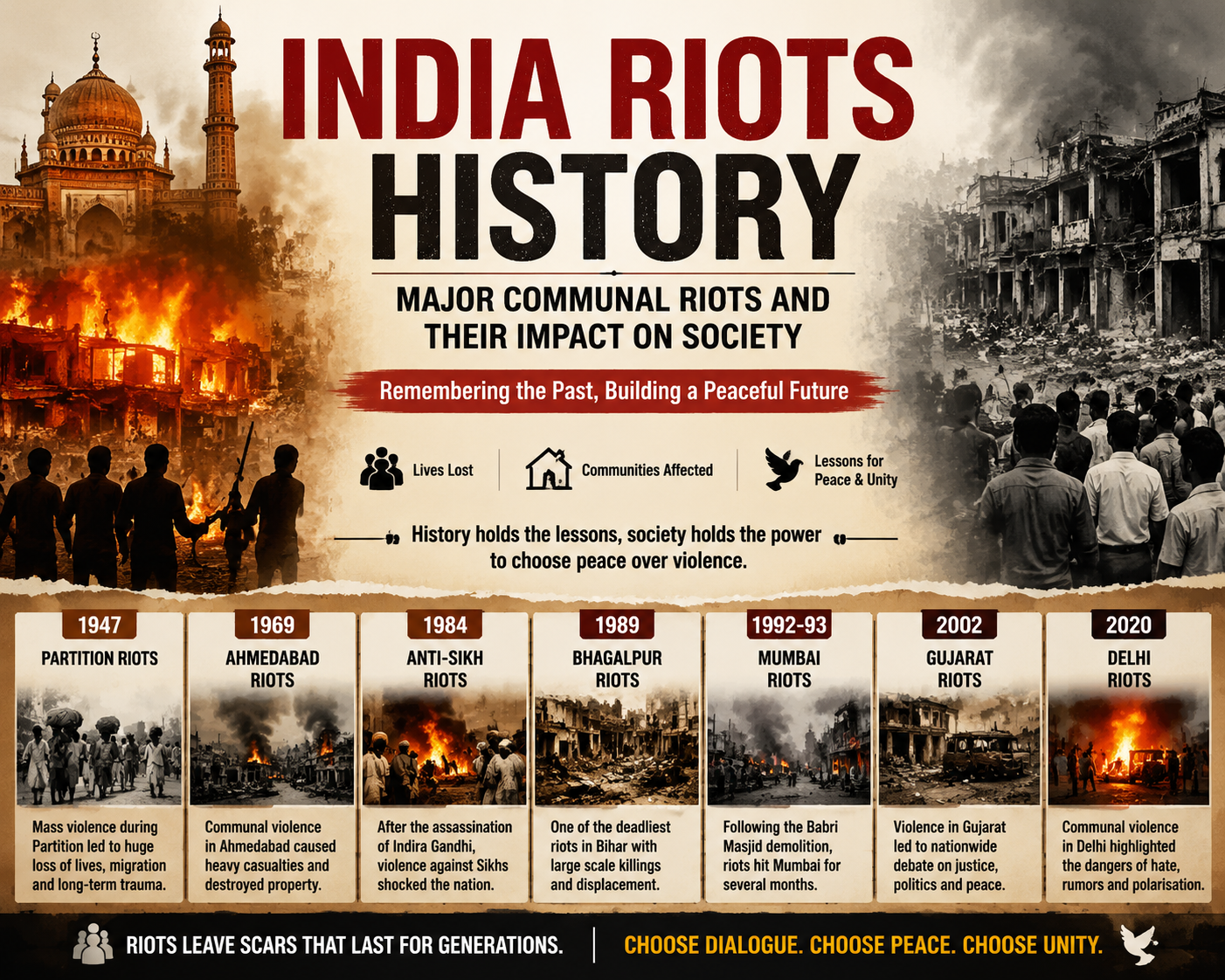
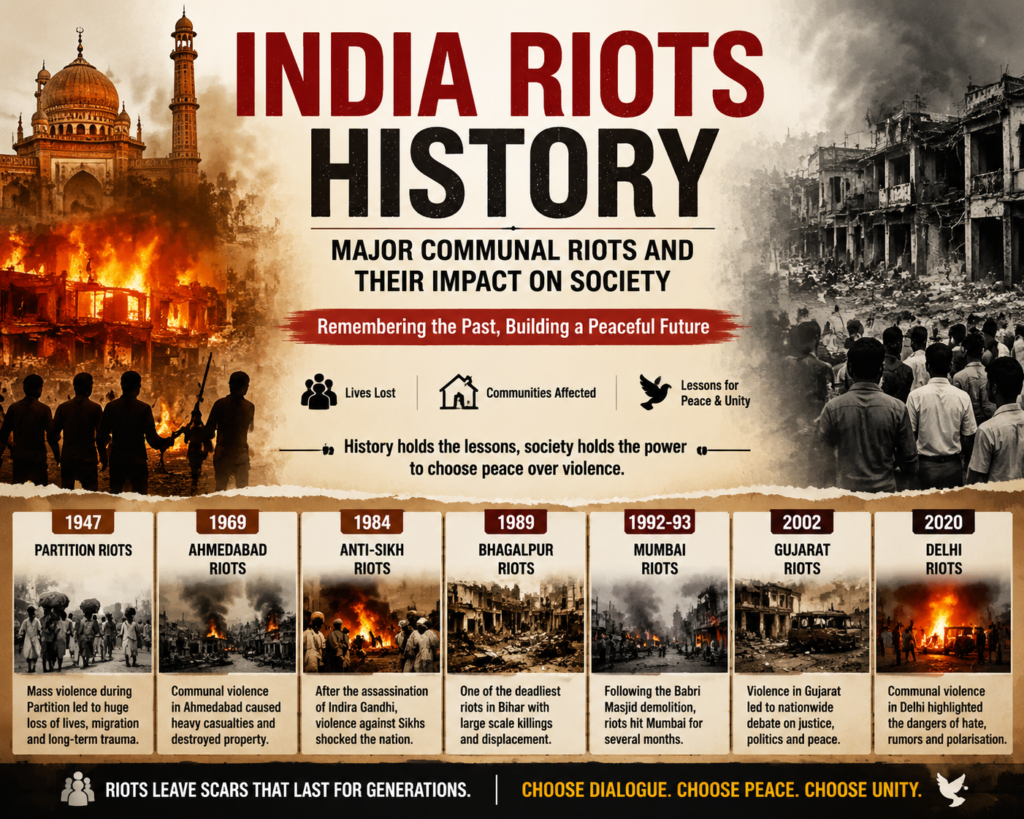
Some major riots in India include the Partition violence of 1947, Ahmedabad riots of 1969, anti-Sikh riots of 1984, Bhagalpur riots of 1989, Mumbai riots of 1992–1993, Gujarat riots of 2002, and Delhi riots of 2020.
Why do communal riots happen in India?
Communal riots can happen due to several reasons, including political conflicts, misinformation, religious tensions, social inequalities, and historical disagreements.
How can India prevent communal violence?
Preventing communal violence requires better education, responsible media, strong law enforcement, quick action during tensions, and cooperation between communities.
Why is studying India’s riot history important?
Studying history helps people understand the causes and consequences of violence, recognize warning signs, and work toward a more peaceful and inclusive society.
Conclusion: Learning From India’s Communal Riot History
The India riots history represents some of the most difficult chapters of the nation’s past. These events caused immense suffering but also provided important lessons about the value of unity, justice, and social responsibility.
The history of communal riots in India history reminds us that diversity can become a strength when communities respect each other. By learning from past mistakes, encouraging dialogue, and rejecting hatred, India can continue moving toward a future based on peace and cooperation.
Understanding history is not about keeping divisions alive. It is about creating awareness so that future generations can build a society where differences are respected and violence is prevented.
