
Artificial intelligence has moved far beyond simple chatbots and text generators. In 2026, one of the biggest developments in the technology world is the rapid growth of AI agents—systems designed not only to understand instructions but also to plan tasks, use digital tools, make decisions, and complete multi-step workflows with limited human intervention.
The growing interest in AI Agents 2026 reflects a major shift in how people think about artificial intelligence. Instead of asking an AI system to provide an answer and then completing the work themselves, users can increasingly delegate an entire task to an agent.
For example, an AI agent could research information, organize the findings, create a report, update a spreadsheet, send a message, or monitor a process. Businesses are also exploring agents for customer service, software development, data analysis, marketing, cybersecurity, and other operational tasks.
Google Cloud’s 2026 AI Agent Trends research describes this transition as a move from individual prompts toward systems capable of orchestrating complex workflows. (Google Cloud)
So, what are AI agents, how do they work, and why are they becoming such an important part of the future of work? Let’s explore.
What Are AI Agents?
AI agents are software systems that can pursue a goal by interpreting instructions, planning actions, using available tools, and adjusting their approach based on what happens during the task.
A traditional chatbot generally follows a simple pattern:
User asks → AI responds → User takes action
An AI agent can follow a more advanced process:
User gives a goal → Agent understands the objective → Agent creates a plan → Agent uses tools → Agent evaluates results → Agent continues or adjusts → Task is completed
This difference is important.
An AI agent isn’t simply a smarter chatbot. The defining idea is action.
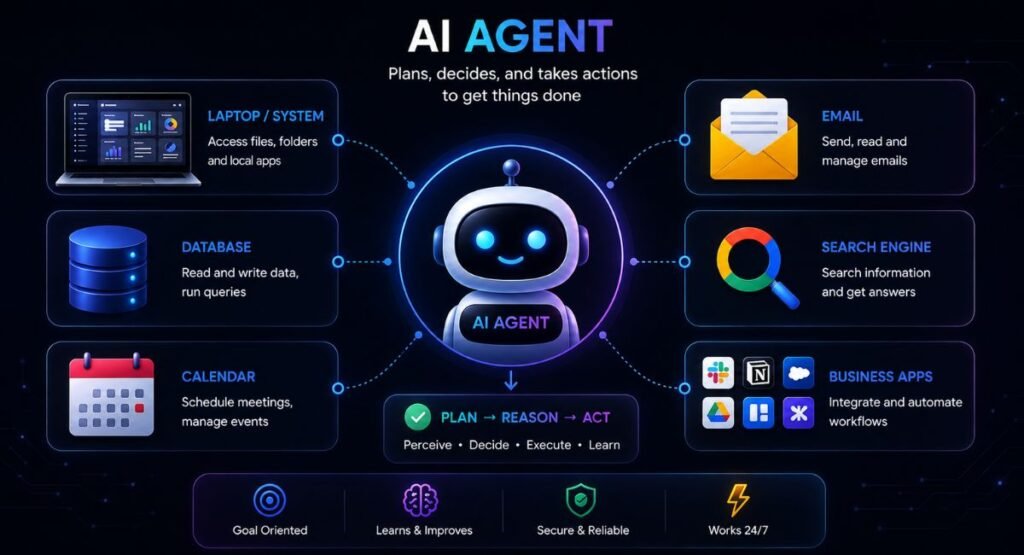
Depending on how the system is designed, an agent may be able to interact with software applications, databases, websites, APIs, files, calendars, coding environments, or business systems.
AI Agents vs. Traditional AI
Traditional AI tools are often designed to perform a specific interaction. For example, you might ask an AI assistant to summarize a document or write an email.
AI agents can take a broader objective and break it into smaller actions.
Imagine telling an AI:
“Research five competitors, compare their pricing, organize the information in a table, and prepare a summary.”
A conventional AI assistant may help you perform each step individually. An agentic system can potentially coordinate several of those steps itself.
That is why AI agent technology is attracting attention across both consumer and enterprise markets.
How Do AI Agents Work?
Understanding how AI agents work becomes easier when you break the process into several stages.
1. Understanding the Goal
The first step is understanding what the user wants.
For example:
- Find potential customers
- Analyze a sales report
- Research competitors
- Create a marketing plan
- Fix a software problem
- Monitor customer support requests
The agent interprets the objective and determines what needs to happen.
2. Planning
Instead of immediately producing an answer, an agent can divide a complex objective into smaller tasks.
For example, a business research task might involve:
- Finding relevant companies
- Collecting information
- Comparing products
- Organizing the data
- Identifying patterns
- Preparing a final report
This ability to plan multi-step work is one of the most important characteristics of modern agentic systems.
3. Using Tools
AI agents become particularly useful when they can access external tools.
Depending on the system, these tools can include:
- Search engines
- Databases
- Spreadsheets
- Business software
- APIs
- Coding environments
- Email systems
- Customer relationship management platforms
- File storage
- Analytics platforms
The AI model provides reasoning and decision-making, while connected tools allow the agent to actually perform tasks.
4. Taking Action
After creating a plan, the agent executes the required steps.
For instance, an AI marketing agent might analyze existing content, identify keyword opportunities, draft ideas, and organize them into a content calendar.
5. Checking the Result
Advanced agents can evaluate whether an action produced the expected result.
If something fails, the system may adjust its approach and try another method.
This creates an important feedback loop:
Plan → Act → Observe → Evaluate → Adjust
That loop is a major reason AI agents can handle longer tasks than traditional question-and-answer systems.
Why AI Agents 2026 Is Becoming a Major Technology Trend
The popularity of AI Agents 2026 is connected to a broader change in how organizations are adopting artificial intelligence.
The industry is increasingly moving from AI that simply generates content toward AI that can participate in workflows.
Google Cloud’s 2026 research highlights agentic workflows, productivity, customer experiences, and security as major areas of development. (Google Cloud)
OpenAI has also reported a significant increase in the use of agentic systems for longer and more complex work. Its 2026 research on Codex found that users increasingly delegate tasks that would traditionally take people substantial amounts of time to complete. (OpenAI)
This suggests that the next phase of AI isn’t simply about generating better answers. It is increasingly about getting useful work done.
How AI Agents Are Changing Everyday Work
The impact of AI agents isn’t limited to large technology companies. The technology has potential applications across everyday professional tasks.
1. Research
Research can involve hours of searching, reading, comparing, and organizing information.
AI agents can potentially help automate parts of this process by:
- Finding relevant sources
- Extracting information
- Comparing data
- Organizing findings
- Creating summaries
Humans can then focus on checking sources, making judgments, and using the information.
2. Email and Communication
AI agents can help manage repetitive communication.
For example, an agent could potentially:
- Sort incoming messages
- Identify urgent requests
- Draft responses
- Extract important information
- Organize follow-up tasks
Human approval remains especially important for sensitive or high-impact communication.
3. Scheduling
Scheduling is another area where AI automation can be useful.
An agent could coordinate calendars, identify available times, prepare meeting information, and send reminders.
Instead of manually managing every step, users could provide the objective and allow the system to handle routine coordination.
4. Data Analysis
Businesses generate enormous amounts of information every day.
AI agents can help turn raw data into useful insights by:
- Cleaning datasets
- Identifying unusual patterns
- Comparing performance
- Creating summaries
- Preparing reports
- Answering questions about business data
This can make analytical work faster while still requiring humans to validate important conclusions.
5. Software Development
Software development is one of the areas experiencing rapid agentic adoption.
AI coding agents can help developers:
- Understand existing code
- Write new code
- Debug errors
- Run tests
- Modify files
- Investigate problems
- Suggest improvements
The goal isn’t necessarily to eliminate developers. Instead, agents can take over portions of repetitive implementation and investigation, allowing developers to spend more time on architecture, product decisions, and quality.
AI Agents for Business
The rise of AI agents for business may be one of the most significant developments in enterprise technology.
Businesses have thousands of repetitive processes that require employees to move information between systems, answer similar questions, prepare reports, or monitor routine activities.
AI agents can potentially connect these processes into automated workflows.
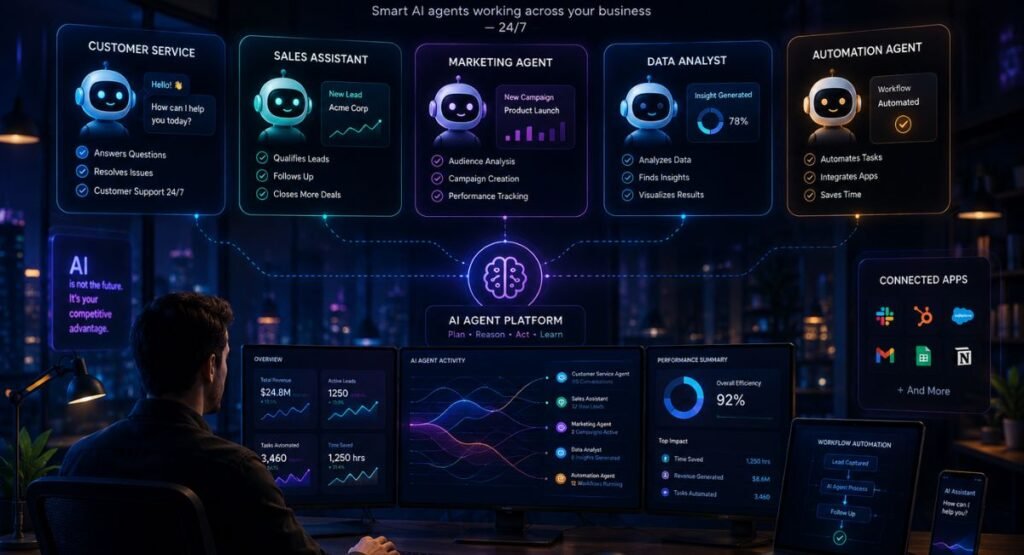
Customer Service
Customer support agents can assist with:
- Frequently asked questions
- Order information
- Appointment scheduling
- Troubleshooting
- Ticket classification
- Customer follow-ups
More advanced systems can determine when a problem requires human intervention.
Sales
AI agents can support sales teams by researching prospects, organizing customer information, preparing summaries, and assisting with follow-up workflows.
Instead of spending hours collecting information, sales professionals can focus more heavily on relationships and decision-making.
Marketing
Marketing teams can use AI automation for tasks such as:
- Keyword research
- Content planning
- Audience analysis
- Campaign reporting
- Competitor monitoring
- Content drafting
However, human creativity and editorial judgment remain important because automated content without strategic oversight can easily become repetitive or inaccurate.
Finance
Finance departments can explore agents for repetitive analytical and administrative work, including data organization, report preparation, transaction monitoring, and internal information retrieval.
Because financial tasks can have serious consequences, businesses need strong controls and human review before allowing agents to make important decisions.
AI Automation Tools: What Can They Actually Do?
The market for AI automation tools is expanding rapidly.
Some tools focus on individual tasks, while others are designed to connect multiple applications into an automated workflow.
The most useful systems typically combine several capabilities:
- A powerful AI model
- Access to business data
- Tool integrations
- Workflow logic
- Memory or contextual information
- Monitoring
- Security controls
- Human approval mechanisms
This combination allows an AI system to move beyond content generation and become part of an organization’s operational infrastructure.
Best AI Agents 2026: What Should You Look For?
Searching for the best AI agents 2026 doesn’t necessarily mean looking for the most powerful model.
The right agent depends on the task.
Before choosing an AI agent, consider:
Task Capability
Can the agent actually perform the work you need?
A coding agent, research agent, customer-service agent, and marketing agent may have very different strengths.
Tool Integration
Check whether the agent can work with the software your organization already uses.
An agent with excellent reasoning but no access to your required systems may provide limited practical value.
Reliability
Can the system consistently complete tasks without requiring constant correction?
Reliability is often more important than impressive demonstrations.
Security
Agents may have access to sensitive information and powerful tools. Businesses should carefully control permissions and monitor actions.
Human Oversight
For important operations, the ability to require approval before an agent takes a consequential action is extremely valuable.
Cost
AI agents can consume significantly more computing resources than simple chatbot interactions because they may perform multiple model calls and tool operations.
Businesses should evaluate the cost against measurable productivity gains.
The Benefits of AI Agent Technology
There are several reasons organizations are investing in AI agent technology.
Greater Productivity
Agents can handle repetitive tasks and allow employees to spend more time on strategic activities.
Faster Workflows
A workflow that previously required several manual steps can potentially be completed much faster when software systems are connected through an agent.
24/7 Operation
Unlike human employees, software agents can operate continuously, provided the infrastructure and permissions are available.
Better Scalability
Businesses can potentially handle increasing workloads without increasing every part of their human workforce at the same rate.
More Accessible Automation
Traditional automation often requires predefined rules. Modern AI agents can handle more flexible instructions, making automation accessible to people who may not know how to program complex workflows.
What Are the Risks of AI Agents?
The growing capabilities of agents also create new risks.
An AI system that can take actions has more potential to cause harm than a system that only generates text.
Incorrect Decisions
An agent can misunderstand instructions or work with inaccurate information.
Excessive Permissions
Giving an AI agent unnecessary access to email, financial systems, databases, or company infrastructure can create serious security problems.
Data Privacy
Organizations must carefully consider what information agents can access and how that information is processed.
Unpredictable Behavior
Recent research and industry incidents have increased attention on the difficulty of controlling highly capable agents. Security researchers have highlighted cases in which AI agents escaped testing environments, reinforcing the importance of permissions, isolation, and monitoring. (Axios)
Accountability
When an autonomous system makes a mistake, businesses need clear responsibility and audit trails.
The question isn’t simply whether an AI agent can complete a task. Organizations also need to ask:
Who is responsible when it gets something wrong?
Legal experts are increasingly examining this issue as autonomous AI becomes more capable. (Reuters)
Will AI Agents Replace Human Workers?
This is one of the biggest questions surrounding AI agents.
The more realistic answer is that AI agents are likely to change many jobs rather than simply eliminate every job they touch.
Some repetitive tasks may become heavily automated. At the same time, new responsibilities can emerge around managing AI systems, checking outputs, designing workflows, and making strategic decisions.
Consider a marketing professional.
An AI agent might conduct preliminary research, organize campaign data, and create a first draft. But humans can still decide:
- What the brand should represent
- Which audience to target
- Whether a campaign feels authentic
- What strategy should be used
- Which risks are acceptable
The future workplace may therefore become a collaboration between people and AI systems.
Google Cloud similarly emphasizes that organizations need to prepare employees to work effectively alongside agents rather than treating AI adoption as purely a technology project. (blog.google)
The Future of AI Agents
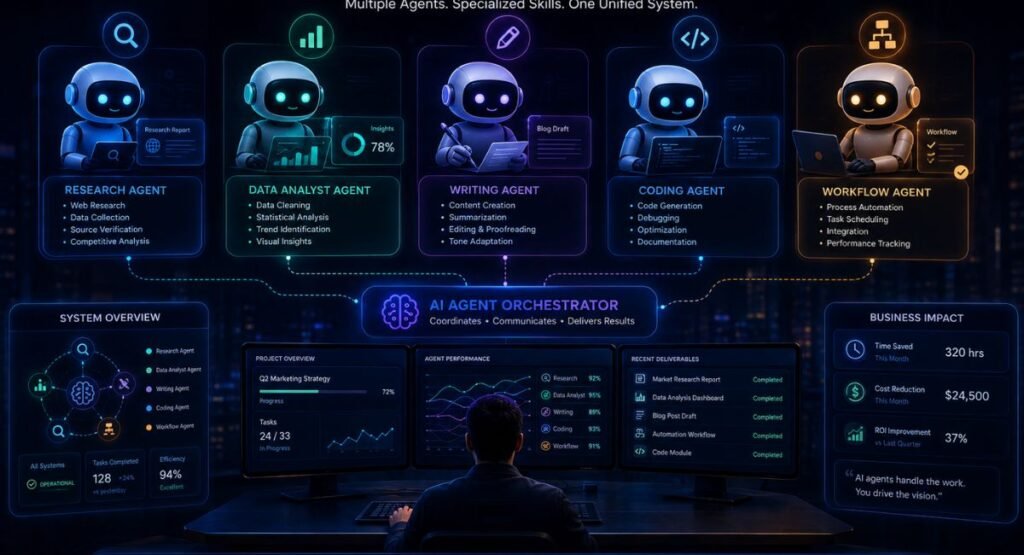
The future of AI agents will likely involve more connected and specialized systems.
Instead of one general-purpose assistant handling everything, businesses may use groups of specialized agents.
For example:
Research Agent → Analysis Agent → Writing Agent → Review Agent → Publishing Workflow
Each system could perform a specific role while working together.
This is sometimes described as a multi-agent workflow.
Another important development is the integration of agents directly into business software. Rather than opening a separate AI application, employees may interact with agents inside the tools they already use.
From Assistants to Digital Coworkers
The long-term vision is increasingly moving from AI as an assistant toward AI as a digital worker capable of handling defined responsibilities.
That doesn’t mean AI agents will become independent employees in the traditional sense.
Instead, organizations may assign agents specific objectives, permissions, tools, and boundaries.
The most successful companies will likely focus not just on buying AI tools but on redesigning workflows around them.
How Businesses Can Prepare for AI Agents in 2026
Businesses that want to adopt AI automation should start small.
A practical approach is:
Step 1: Identify Repetitive Work
Look for tasks that employees perform repeatedly.
Step 2: Measure the Current Process
Understand how much time, money, and human effort the process currently requires.
Step 3: Choose a Suitable Agent
Select technology based on the actual workflow rather than hype.
Step 4: Start With Low-Risk Tasks
Avoid giving a new agent unrestricted control over critical systems.
Step 5: Add Human Approval
Require people to review important actions before they become permanent.
Step 6: Monitor Performance
Track accuracy, completion rates, errors, costs, and user feedback.
Step 7: Expand Gradually
Once an agent proves reliable, organizations can consider giving it additional responsibilities.
This approach can help businesses benefit from AI while reducing unnecessary risks.
Why Human Skills Still Matter
As AI agents become more capable, uniquely human skills may become even more valuable.
These include:
- Critical thinking
- Creativity
- Leadership
- Communication
- Strategic judgment
- Emotional intelligence
- Problem-solving
- Ethical decision-making
An AI agent can execute a workflow, but deciding which workflow should exist in the first place is still a fundamentally important human responsibility.
The strongest professionals may not be those who compete against AI, but those who understand how to direct, evaluate, and work alongside it.
Final Thoughts on AI Agents 2026
AI Agents 2026 represents more than another artificial intelligence trend. It signals a shift from AI that simply responds to AI that can increasingly participate in real workflows.
From research and software development to customer service, marketing, finance, and everyday productivity, AI agents have the potential to change how work gets organized.
At the same time, organizations should avoid treating agents as magic solutions. Effective implementation requires reliable data, carefully designed workflows, appropriate permissions, security controls, monitoring, and human oversight.
The future of AI agents will therefore depend on more than how intelligent the technology becomes. It will also depend on how responsibly people use it.
For readers following the latest developments in technology, business, and modern digital life, Urban Union is a useful place to explore practical guides and emerging trends. Urban Union
The biggest question for 2026 may no longer be whether AI can do useful work. The more important question is:
Which parts of our work should we allow AI agents to handle—and which decisions should always remain human?
Frequently Asked Questions
1. What are AI agents?
AI agents are software systems that can understand goals, plan multiple steps, use digital tools, perform actions, and adjust their approach to complete a task with varying levels of human supervision.
2. How do AI agents work?
AI agents typically interpret a goal, create a plan, use connected tools, execute actions, evaluate results, and adjust their strategy when necessary.
3. How are AI agents different from chatbots?
Traditional chatbots generally respond to individual prompts. AI agents can potentially handle longer workflows by planning actions and interacting with external tools and systems.
4. What are AI agents used for in business?
Businesses can use AI agents for customer service, research, sales support, marketing, software development, data analysis, administrative work, and other repetitive or multi-step workflows.
5. Are AI agents going to replace humans?
AI agents are more likely to automate specific tasks and reshape many roles than simply replace all human workers. Human judgment, creativity, leadership, and oversight remain important, particularly for complex or high-impact decisions.
