
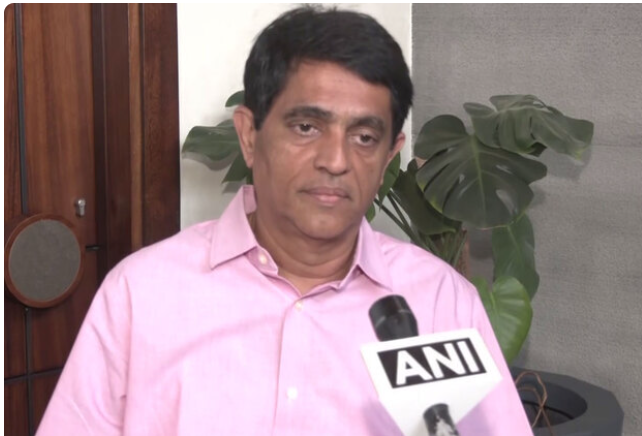
In a sharp and pointed rebuke that has reignited the long-simmering debate over inter-state relations between Andhra Pradesh and Telangana, YSR Congress Party (YSRCP) senior leader and former Andhra Pradesh Finance Minister Buggana Rajendranath has publicly condemned the recent remarks made by Andhra Pradesh Deputy Chief Minister and Jana Sena Party chief Pawan Kalyan regarding Telangana. Speaking in a candid interview with ANI, Rajendranath called Kalyan’s statements “wrong” and issued a stern reminder to political figures that public life comes with the responsibility of understanding — and not inflaming — the emotions of ordinary people.
The controversy, which has snowballed over the past several days, has once again brought questions of regional identity, political rhetoric, and the unresolved wounds of the 2014 bifurcation of Andhra Pradesh to the forefront of Telugu political discourse. What began as a journalistic observation has since escalated into a charged exchange involving senior politicians, media personalities, and regional communities on both sides of the border.
Rajendranath’s Critique: Facts YSR Congress Over Emotion
At the heart of Rajendranath’s criticism is a fundamental question about the conduct expected of those in public life. “It is very wrong. The reason is that you have to understand politics. You have to understand the sentiments of the people. You have to understand emotions,” Rajendranath said pointedly, underscoring the view that political leaders must exercise restraint and empathy when responding to public commentary.
The former finance minister was particularly critical of the manner in which Pawan Kalyan and his supporters chose to respond to what he described as an observation made in good faith by a prominent media figure. Rajendranath stressed that the correct approach in such situations is to engage with the substance of any criticism factually and calmly, rather than allowing matters to escalate into an emotionally charged regional confrontation.
“This started with an observation made by one of the most respected figures in Indian journalism today — Prof. Nageshwar. He made a statement. If there is something that is not correct about that statement, you should come forward and give a factual explanation,” Rajendranath said, referring to Prof. Nageshwar, a veteran journalist and former Member of the Legislative Council widely regarded as a credible and authoritative voice in Andhra Pradesh and Telangana political circles.
Rajendranath’s argument rested on a basic principle of democratic participation: those who voluntarily enter public life and seek political office must accept that they will be subject to commentary, analysis, and criticism. To respond to such scrutiny with hostility — or worse, to frame it as an attack on regional pride — is, in Rajendranath’s assessment, both politically immature and potentially dangerous.
“When you are in public life, people are going to make statements. You cannot expect to be in public life and not know that,” he said, his remarks carrying an unmistakable note of exasperation at what he sees as a pattern of thin-skinned responses from those in power.
From Journalism to Political Flashpoint: How the Controversy Escalated
To understand the full context of Rajendranath’s criticism, it is necessary to trace the series of events that led to this moment. The controversy reportedly began when Prof. Nageshwar made a public statement touching on political developments related to Telangana and certain political figures. The exact nature of the remark has since become a matter of debate, but its impact was significant: it prompted a fierce and, by many accounts, disproportionate reaction from Pawan Kalyan and figures associated with the Jana Sena Party.
Rather than addressing the substance of Prof. Nageshwar’s observation through a measured public response or press briefing, the reaction quickly took on the character of regional defensiveness. Accusations and counter-accusations began to fly, and what might otherwise have remained a contained political debate rapidly expanded into something larger and more volatile — a perceived conflict between Andhra and Telangana identities.
“You cannot simply say that someone shouldn’t make a statement; he made one. It has now snowballed into some sort of an Andhra versus Telangana regional issue,” Rajendranath said, visibly frustrated by the trajectory of events.
This “snowballing” dynamic is not new to the region. Ever since the bifurcation of the undivided Andhra Pradesh in 2014 — a decision that created the separate state of Telangana and retained the rump state of Andhra Pradesh — political leaders on both sides have periodically stoked regional sentiments for electoral and rhetorical advantage. The creation of two Telugu-speaking states sharing a common language, culture, and history but divided by political lines has created an environment in which even minor controversies can quickly acquire the dimensions of a full-blown identity crisis.
Pawan Kalyan’s Remarks: Assertiveness or Provocation?
The immediate trigger for the current controversy was a press conference held by Pawan Kalyan, in which the Deputy Chief Minister reacted sharply to what he described as threats made by unnamed local politicians in Telangana — individuals who had allegedly questioned his right or ability to enter Hyderabad, the city that serves as the shared capital of both states under a constitutionally mandated arrangement set to last ten years from the date of bifurcation.
Pawan Kalyan did not mince words. Addressing those who had made such statements directly, he asked: “A few leaders are saying how I will enter Hyderabad. Is Telangana your father’s place? Who are you to threaten me?” The remarks, combative and charged with regional undertone, were widely reported and drew reactions from across the political spectrum.
While many of Kalyan’s supporters praised the Deputy Chief Minister for standing his ground and refusing to be cowed by what they characterised as petty political intimidation, critics argued that his choice of language was unnecessarily confrontational and risked inflaming already sensitive inter-state relations. For YSRCP’s Rajendranath, the remarks represented exactly the kind of reckless political communication that public leaders can ill afford.
Beyond the immediate controversy, Pawan Kalyan also chose the occasion to revisit his longstanding dissatisfaction with the manner in which the bifurcation of Andhra Pradesh was carried out in 2014. In remarks that touched on a raw nerve for many in the region, he suggested that the process had been handled without adequate respect for the people on both sides of the new border.
“Our grievance is that the state division was not done with dignity and Telangana state was not given properly,” he said — a statement that, depending on one’s perspective, could be read either as a sympathetic acknowledgment of Telangana’s legitimate aspirations or as a belated attempt by an Andhra politician to claim ownership of a cause that was fundamentally driven by the Telangana movement.
Kalyan’s Position on Telangana: A History of Nuance
To be fair to Pawan Kalyan, he has consistently positioned himself as something of a bridge between the two Telugu-speaking states, and his record on the Telangana question is more nuanced than his recent inflammatory remarks might suggest. In a post on X (formerly Twitter) published on Thursday — just days before the press conference that sparked the latest controversy — Kalyan took pains to articulate his historical stance on Telangana’s formation.
“Following the bifurcation of Andhra Pradesh, while certain law and order concerns were raised, I clearly opposed the implementation of Section 8, as I believed it would undermine the self-respect and right to self-governance of the people of Telangana,” Kalyan wrote. Section 8 referred to a provision related to governance arrangements in the aftermath of bifurcation, and Kalyan’s opposition to it was, at the time, seen as a significant gesture of solidarity with the Telangana cause.
He continued: “I have always maintained that respecting the aspirations and rights of the people of Telangana is as important as addressing the security concerns of the people of Andhra Pradesh.” The statement reflected a desire to be seen as a leader who transcends regional divisions and speaks for all Telugu-speaking people — a brand of politics that has served Kalyan’s Jana Sena Party reasonably well in building a cross-regional identity.
Yet critics argue that however measured his written statements may be, Kalyan’s verbal interventions at press conferences and public events often tell a different story. The gap between the measured tone of his Thursday X post and the combative register of his press conference remarks has not gone unnoticed, and it is this inconsistency that Rajendranath and others are calling out.
The Broader Context: Unfinished Business of Bifurcation
The current controversy cannot be fully understood without acknowledging the deep and unresolved issues that have lingered in the wake of Andhra Pradesh’s bifurcation over a decade ago. The division of the state was one of the most contentious political events in recent Indian history, involving years of agitation, political negotiations, and ultimately a parliamentary decision that satisfied neither side completely.
Telangana was finally carved out as a separate state in June 2014, giving the region a long-sought identity and political autonomy. But the division left a trail of complicated questions: the sharing of river waters, the division of assets and liabilities, the status of government employees, and — most symbolically charged of all — the future of Hyderabad, the gleaming metropolis that both states claim as their own.
Under the terms of the Andhra Pradesh Reorganisation Act of 2014, Hyderabad was designated the joint capital of both Telangana and Andhra Pradesh for a period of up to ten years, after which it would become the exclusive capital of Telangana. That transition period has now ended, and Hyderabad is constitutionally and legally the capital of Telangana alone. Against this backdrop, any suggestion — real or perceived — that politicians from Andhra Pradesh have a special stake in or right over Hyderabad is bound to provoke strong reactions from Telangana’s political class and general public.
It is in this context that the threats allegedly made by local Telangana politicians regarding Pawan Kalyan’s visit to Hyderabad need to be situated. While such threats are unquestionably inappropriate and legally indefensible, they are also symptomatic of the underlying anxieties and competitive tensions that continue to shape inter-state relations in the region.
A Call for Responsible Leadership
What emerges most clearly from Rajendranath’s interview is a broader call for a higher standard of political conduct — one YSR Congress that prioritises facts over feelings, dialogue over confrontation, and long-term regional harmony over short-term political points.
“You have to understand the sentiments of the people,” he said — and the remark cuts in two directions. It is a reminder to Pawan Kalyan that his words carry weight and consequences, particularly when spoken as the holder of high constitutional office. But it is also a reminder to all political actors in the region that the people of both Telangana and Andhra Pradesh have suffered enough from the politics of division and deserve leaders who will work to heal rather than deepen the fault lines left by bifurcation.
As the exchange between political figures from both states continues to draw attention, ordinary citizens in Hyderabad and beyond are watching closely — hoping that their elected representatives will choose the path of reason, respect, and regional cooperation over the easier but ultimately destructive path of populist provocation.
